
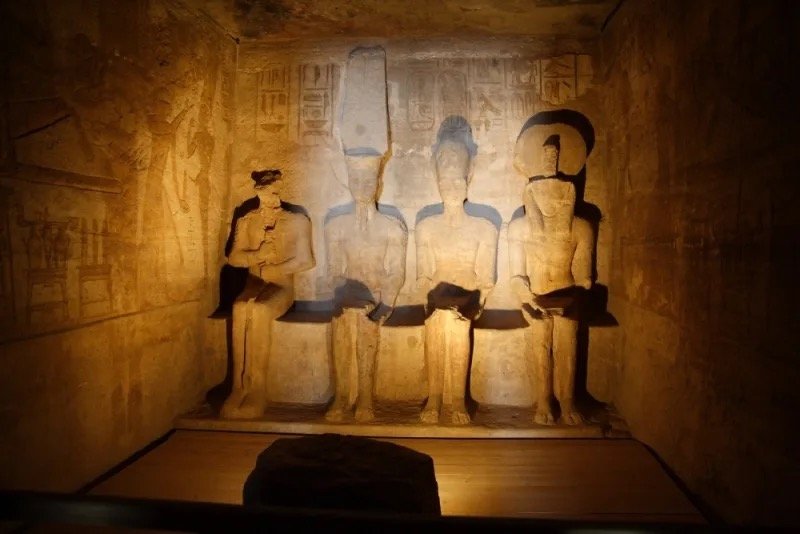

Deep in southern Egypt, on the western bank of Lake Nasser, stands one of the most extraordinary monuments of ancient Egypt: the Abu Simbel Temples. Built during the reign of King Ramses II, these magnificent temples are famous not only for their enormous statues and detailed carvings, but also for an incredible solar phenomenon that takes place inside the Great Temple.
Twice a year, sunlight enters the temple and travels through its long sanctuary, illuminating the statues of the ancient gods and King Ramses II in a remarkable display of ancient Egyptian engineering and astronomical knowledge.
When Does the Sun Align with King Ramses II?
The solar alignment at Abu Simbel traditionally occurs twice each year, around February 22 and October 22.
On these mornings, the rising sun sends a beam of light deep into the Great Temple of Ramses II. The sunlight passes through the temple entrance and corridors before reaching the sanctuary at the very back.
There, the rays illuminate three of the four seated statues carved into the sanctuary wall: Ra-Horakhty, Ramses II, and Amun-Ra.
The fourth statue, representing Ptah, the god associated with the underworld, remains in darkness.
This extraordinary event has made Abu Simbel one of Egypt’s most fascinating destinations for travelers interested in ancient history, architecture, and astronomy.
How Did the Ancient Egyptians Achieve This?
The precision of the temple’s orientation is one of the reasons the solar phenomenon is so impressive.
The ancient Egyptians carefully positioned the Great Temple so that sunlight could penetrate deep inside it at particular times of the year. The alignment demonstrates the sophisticated understanding of the sun’s annual movement and the relationship between architecture and astronomy in ancient Egypt.
The phenomenon is not simply a beautiful visual effect. It is believed to have had an important symbolic connection to the power and divinity of the pharaoh.
For the ancient Egyptians, sunlight represented life, creation, and divine power. Allowing the sun’s rays to reach the image of Ramses II inside the sanctuary may have reinforced the king’s connection with the gods.
Why Is Ramses II Illuminated?
Ramses II was one of the most powerful and celebrated pharaohs of ancient Egypt. He ruled for more than six decades and commissioned enormous monuments throughout Egypt.
At Abu Simbel, his image dominates the Great Temple. Four colossal statues of Ramses II sit at the entrance, each reaching approximately 20 meters high.
Inside the temple, the solar alignment creates another symbolic connection between the king and the divine.
When the sunlight reaches his statue, Ramses II appears illuminated alongside the gods, creating a powerful representation of the pharaoh’s divine status and eternal presence.
The Mystery of Ptah Remaining in Darkness
One of the most fascinating details of the phenomenon is that the statue of Ptah remains untouched by the sunlight.
Ptah was associated with the underworld and with creation, craftsmanship, and artisans. Whether this was intentionally designed to keep Ptah in darkness remains a subject of discussion among historians and Egyptologists.
Regardless of the interpretation, the contrast between the illuminated figures and Ptah standing in shadow makes the event even more fascinating.
Abu Simbel: A Temple Saved from the Waters
There is another remarkable chapter in the story of Abu Simbel.
During the construction of the Aswan High Dam in the 1960s, rising waters from the creation of Lake Nasser threatened to submerge the temples.
An international campaign, supported by UNESCO, led to an enormous rescue operation. Between 1964 and 1968, the temples were carefully dismantled and reconstructed on higher ground, approximately 65 meters above their original location.
Engineers worked to preserve the temple’s orientation and solar alignment during the relocation.
The fact that the phenomenon continues to occur today is a testament to the extraordinary precision of both the ancient builders and the modern engineers who saved Abu Simbel.
Why Should You Visit Abu Simbel?
Witnessing the solar phenomenon at Abu Simbel is a unique experience for anyone traveling through Egypt.
Beyond the famous alignment, visitors can admire the colossal statues of Ramses II, beautifully preserved reliefs, monumental columns, and scenes depicting the king’s victories and religious life.
The temple’s remote location in southern Egypt also adds to its sense of mystery and adventure.
Whether you are passionate about ancient Egyptian history, fascinated by astronomy, or simply looking for one of Egypt’s most unforgettable experiences, Abu Simbel should be high on your travel itinerary.
Experience the Magic of Ancient Egypt
The solar alignment at Abu Simbel is more than an impressive light phenomenon. It is a remarkable example of how ancient Egyptian architecture, religion, astronomy, and royal power were brought together in a single monument.
Thousands of years after Ramses II commissioned his magnificent temple, the rising sun continues to enter the sanctuary and illuminate the king’s image — reminding us of the extraordinary achievements of ancient Egyptian civilization.
Abu Simbel is not simply a place to visit; it is a place where history, astronomy, and architecture come together in one unforgettable experience.
0 Comment